Deposition summary Model proposes, code decides

A model drafts the points. It never sees a page number.

The model receives the witness's answers and nothing that could become a citation. Code attaches every page and line afterwards, rebuilds every quotation from the transcript, and refuses points the testimony does not support. Then you decide each one.

What the model was given

An answer, labelled only unit-07: I think I was going maybe five miles an hour.

Refused by code Lost qualifier

A point that says She was going five miles an hour drops I think and maybe.

Kept for your review Cite attached by code

The witness thinks the witness was going maybe five miles an hour just before the light. Code attached [Tr. 2:12–13] from its own record of where the answer sits.

The kept point and its cite are from the saved run in the demo, on the invented deposition. The refused point is an illustration, and the unit label is made up for this picture.

The boundary

What the model sees, and what stays on your side.

Page and line numbers travel around the model, not through it. A model cannot get a citation wrong if it is never given one and never asked for one.

The record

Transcript

  • Read by code
  • Every line placed at its page and line
  • Every line labelled: question, answer, objection, colloquy
Sent to the model

Evidence package

  • The witness's complete answers
  • The one question each answer responds to, marked as context
  • Your issue list
  • A made-up label for each answer

Model

proposes points
Code

Checks, then cites

  • Is every word supported by the answers it names?
  • Did a number, a not or a hedge change?
  • Whose words are these?
  • Then: attach page and line, rebuild quotations from the transcript
You

Reviewer

  • Reads each point beside the cited lines
  • Keeps it, changes it or leaves it out
  • Nothing is exported before that
Never sent

Private record

  • Which page and lines each label stands for
  • The PDF itself
  • The exact words for quotations
Refused, with the reason

Rejects

  • Unsupported wording
  • A number the witness never gave
  • A lost qualifier
  • A flipped meaning
  • Attorney speech

Sent to the model Stays with the code, never sent

The evidence package

Exactly what goes in, and what cannot.

The model receives

  • The witness's answers, each one complete
  • For each answer, the single question it responds to, labelled as context and never as testimony
  • The issues you asked about, in your order and your words
  • A label for each answer that means nothing outside this run

The model never receives

  • The PDF, or any path to it
  • Page numbers or line numbers
  • Citations, or quotations formatted for a report
  • Objections, attorney statements or colloquy
  • Any answer that crosses a redaction box on the page

What code rejects

Six ways a proposed point is refused.

A refused point is rejected or flagged. It is never quietly repaired. The examples below are illustrations written against the invented demo deposition.

New content

The point brings in wording that is not in the evidence it names.

The truck was speeding when it hit her.

An unsupported number

The point states a number the witness never gave.

She lifted cases of fifty pounds.

A lost qualifier

The point drops about, I think or I don't recall.

She had not that she recalls never been treated for neck pain.

A flipped meaning

The point says the opposite of the answer.

She was stopped still moving when she was hit.

The wrong speaker

The point is built on something an attorney said.

Q. So you were still moving when you were hit?

Reported speech

The point treats a document read aloud as the witness's own account.

Reading from an exhibit is not testimony about the events.

Review and export

A passing check is not a review. You decide every point.

  1. Check the pages

    Confirm how the transcript reads: which pages are testimony and which were left out.

  2. Settle who said what

    Lines the reader could not place with certainty wait for you. They are not sent to the model as testimony.

  3. Read each point against the record

    Click a citation and the page moves to it, with the lines the point rests on highlighted. Keep the point, change it or leave it out.

  4. Your edits are checked too

    An edit that drops a qualifier or changes the meaning is refused, the same way a model's wording would be.

  5. Export a Draft, a Final or a Client copy

    Word and PDF. Each document is read back and compared with what you approved before it is offered. The Client copy is the Final without the review record.
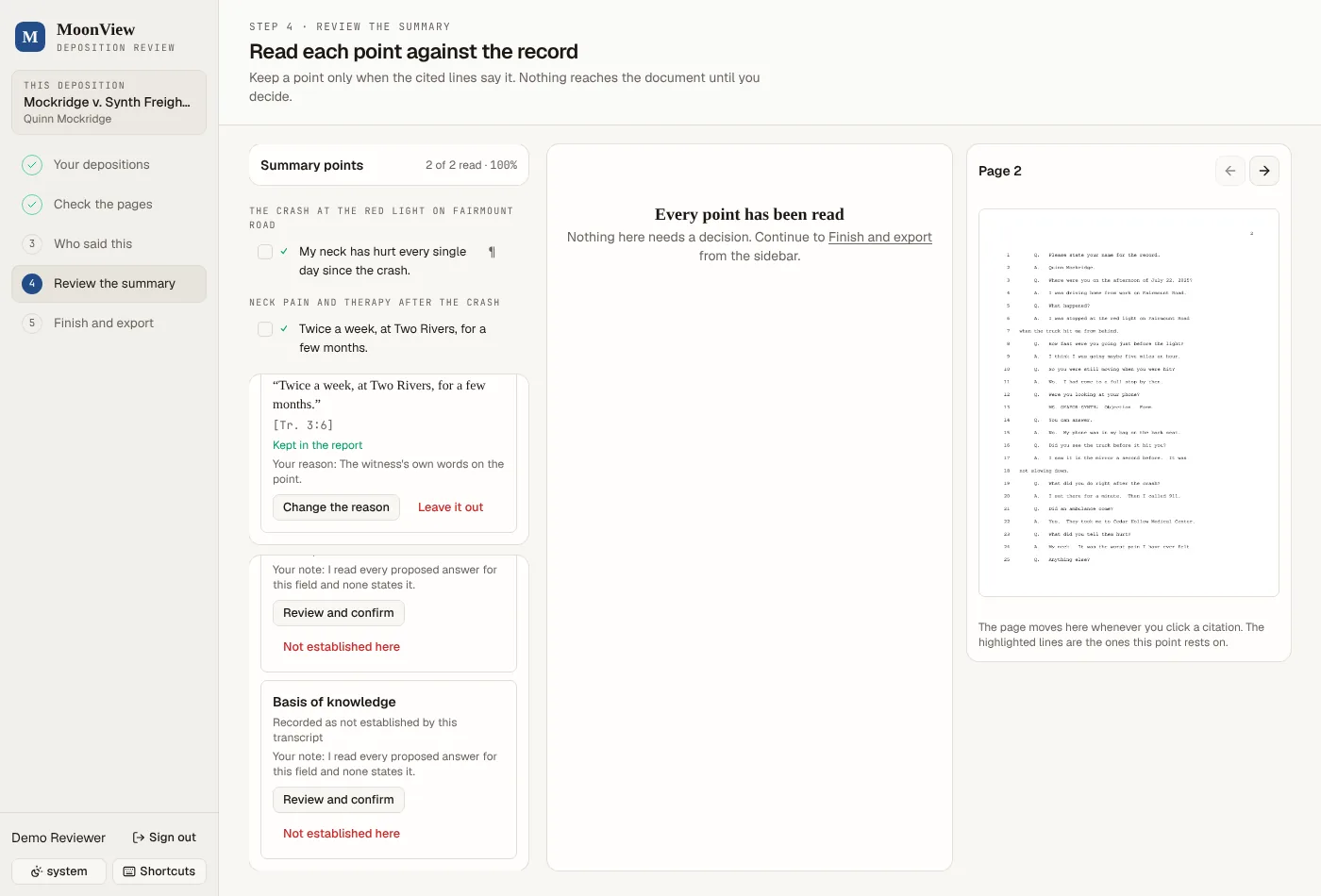
Review the summary
The review screen for the invented demo deposition: a list of summary points grouped by issue, a kept point with its transcript cite, and the cited page of the transcript on the right.Open full size
The review screen on the invented demo deposition. The program's working name is Transcript Check, and the captures on this site are from code later than the preview build. This capture is from a test mode with two points, not a model run.
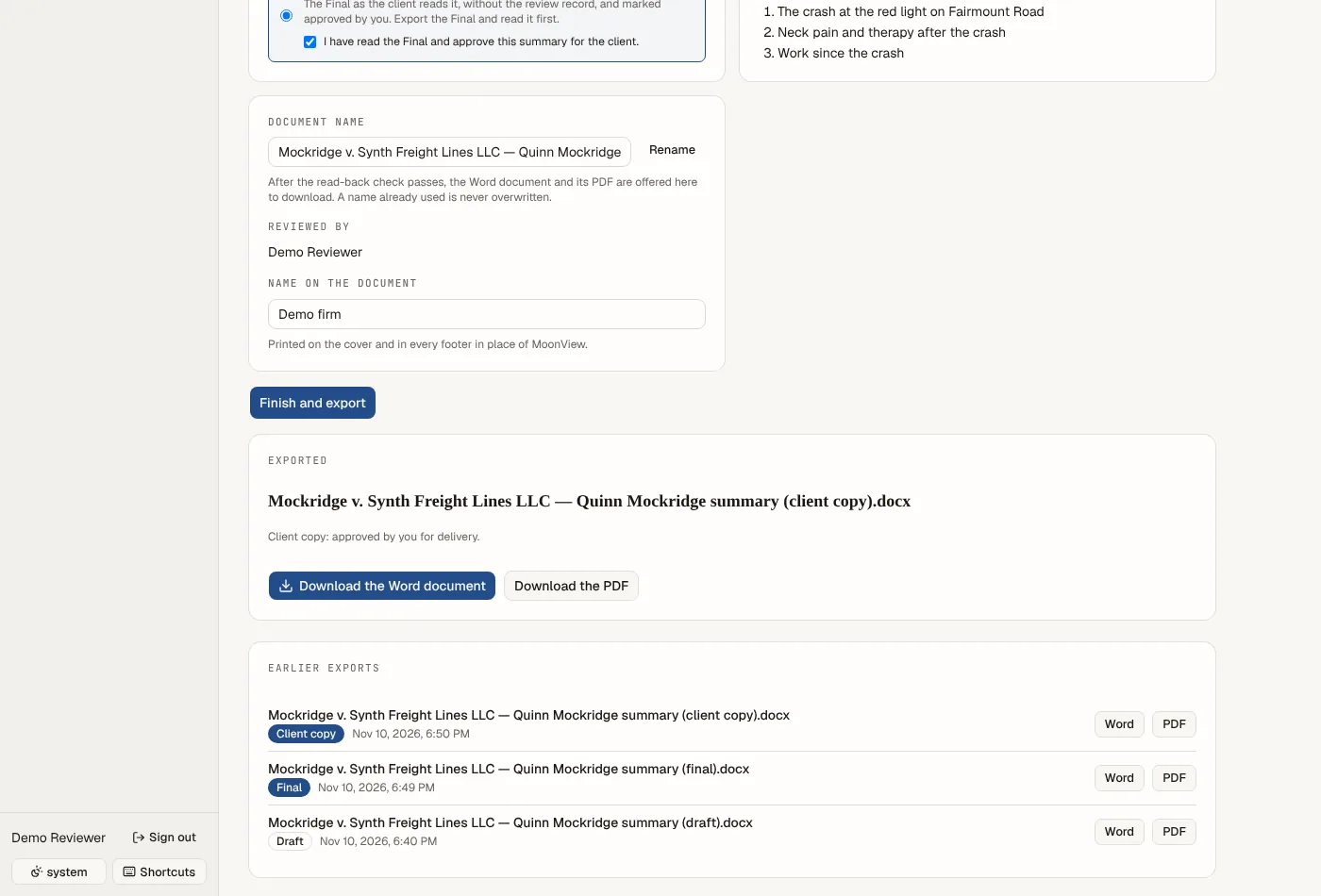
Finish and export
The export screen listing a Draft, a Final and a Client copy of the demo summary, each with Word and PDF buttons.Open full size
Draft, Final and Client copy, each in Word and PDF. Invented demo matter.

Measured, in our own tests

Results from paid runs on public filings.

Deposition transcripts filed publicly in court, run through a commercial model on 30 Oct 2026. Every kept point was then evaluated for its citation and its speaker. These are our own tests, not customer results.

Kept points with a wrong citation
0 of 334
Six public filings. None put words in the wrong mouth either. 30 Oct 2026. 2
Share of proposed points that code kept
27%
The rest were refused. 6 of the 334 kept points still needed a reviewer's attention. 30 Oct 2026. 2
Meaning-changing edits accepted from a reviewer
0 of 697
Probe edits written to change the meaning of a point, on a synthetic transcript. 27 Oct 2026. 2

Limits

What the summary cannot do yet.

  • Most of what the model proposes is refused. In the paid runs code kept 27% of proposed points. The summary that survives is supported, and it can be thinner than one written by hand.
  • Two meaning-changing probes got through. Of 574 probe points written to change the meaning of an answer, the check on a model's points accepted 2 (28 Oct 2026). Both drop a hedge the answer gives in a later clause. 14 more take words from the question and wait for the reviewer to confirm that context. Synthetic transcript.
  • The checks are strict to a fault. Some honest rewordings are refused along with the bad ones. In those runs a point was refused over goes where the witness said go.
  • Two runs differ. The same transcript run twice gives different points. The model's output is saved with each review so the review always refers to one fixed run.
  • Tested on public transcripts and synthetic files only. Client transcripts are not sent to an outside model service while that question is open.
  • The demo shows one saved run. The summary in the demo is a single saved model run on the invented deposition from 10 Nov 2026, with 12 points. The site does not call a model for you.
  • No conclusions. It does not give legal advice, strategy or a view on whether a witness is credible.

Read a saved run, point by point.

Each point with the citation code attached, the testimony beside it, and what code rejected.