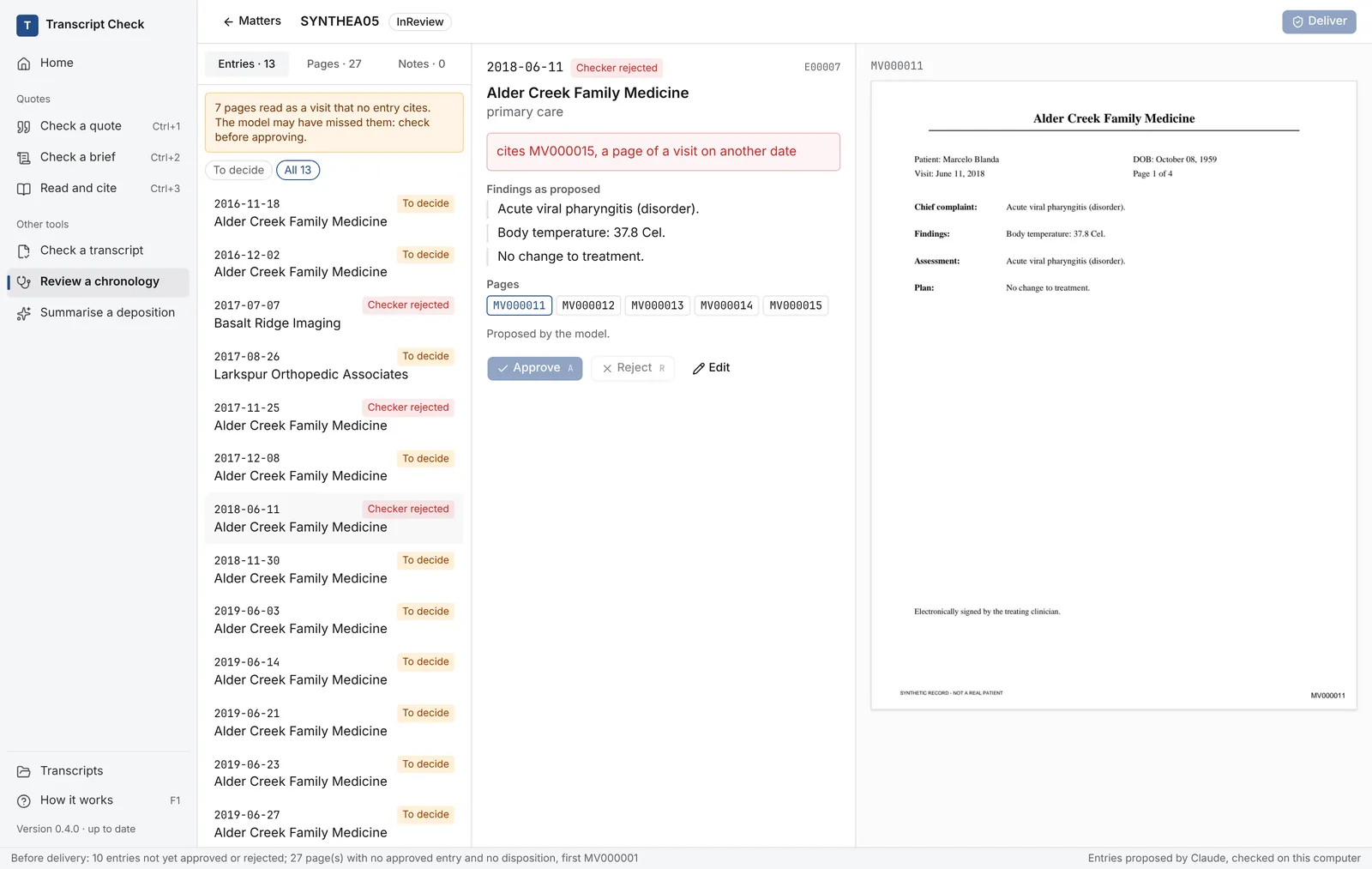
A wrong date
The entry's date is not the date of service printed on its page.
Tested on synthetic records only. No real client record has been through this tool. Every patient, provider and page shown here is invented.
Medical chronology Synthetic records only
Today the chronology is run as a reviewed service: a firm sends records, and a reviewer approves every entry beside its page. OCR runs on the machine that holds the records. To draft entries, the text of each visit's pages is sent to an outside model service; for client records that step stays off until a business associate agreement is signed. So far only synthetic records have been through it.
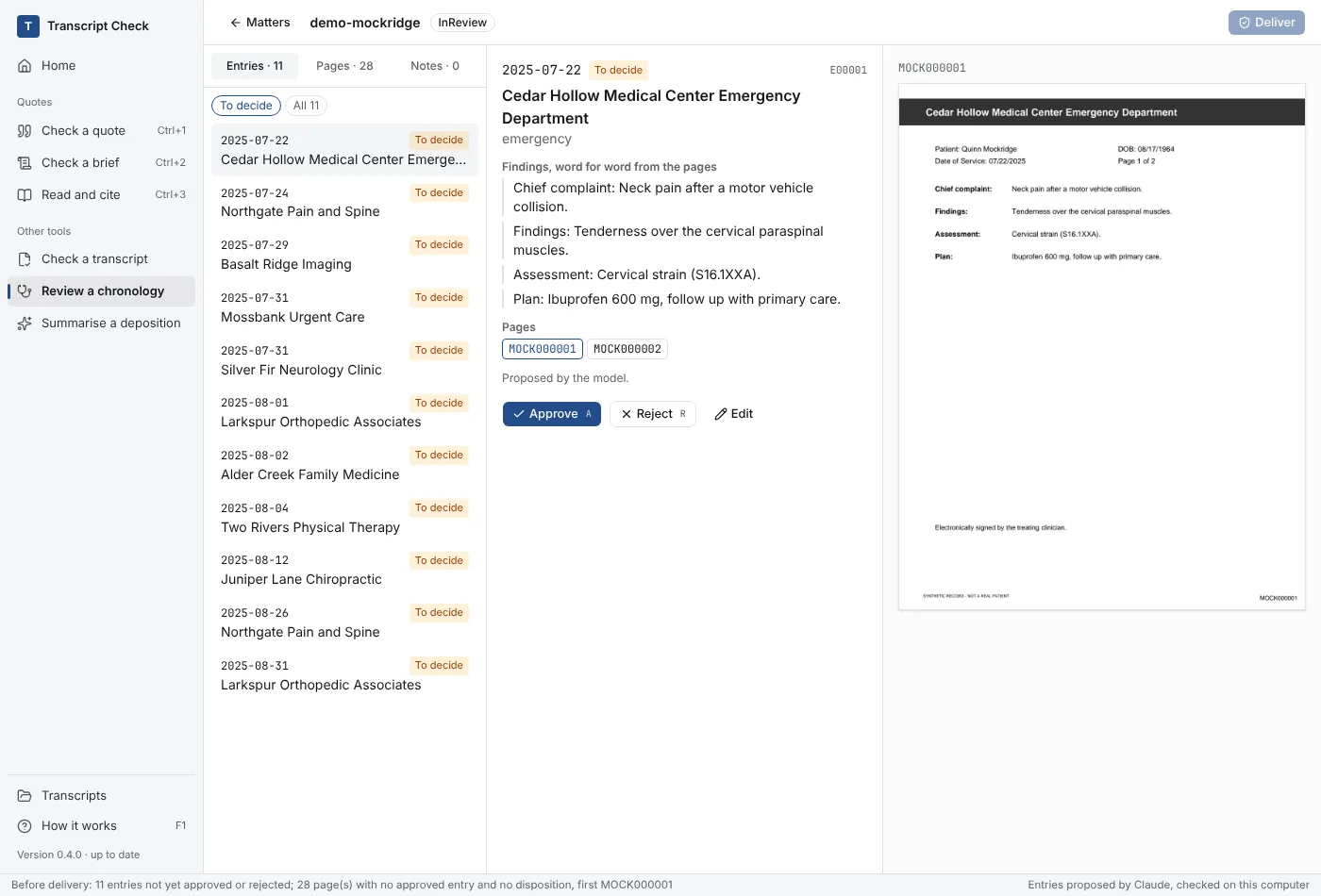
2025-07-22To decide
Cedar Hollow Medical Center Emergency Department
Findings, word for word from the pages
MOCK000001MOCK000002
Proposed by the model. Every word found on the cited page.
The pipeline
Each stage is done by code, by a model or by the reviewer. The model's only job is to propose. It decides nothing.
The firm's PDFs are received once an authorization is on file. Every page gets a Bates number and a row in the page list.
CodeOCR runs locally, on the machine that holds the records. Blurred, faint and handwritten pages are marked low.
CodeA model drafts one entry per visit, quoting whole sentences from the pages. This is the one step where page text leaves that machine.
ModelEvery proposed word is compared with the text of the page the entry cites.
CodeThe reviewer approves, rejects or edits each entry with the page image next to it.
ReviewerOnly when every entry has a decision and every page is accounted for. Word, PDF and Excel.
CodeEach file is opened again and compared with the entries the reviewer approved.
CodeThe records, the entries and the service's copy of the report are deleted, 30 days after delivery unless another time is set.
CodeWatch how it works
An animated walk from intake to purge, including four kinds of entry the checker refuses. Use the arrows to step through at your own pace. On a narrow screen the same steps are shown as a list.
Synthetic records only. The explainer follows a different invented case from the demo.Open the explainer on its own page
What the checker refuses
Findings are quoted, not paraphrased, so code can check them. An entry is refused if any of these is true. A refused entry goes to the reviewer's list with the reason. The reviewer fixes it against the page, and the fix is checked again.
The entry's date is not the date of service printed on its page.
The entry mixes in a page from a different provider, even one seen the same day.
A quoted sentence stops short of what the page says.
A No
in front of a finding, or any word the page does not have.
The entry cites a page that belongs to a visit on a different date.
Citations stay inside the matter they came from.
An entry called an emergency visit on a page from a physical therapy clinic.
A billed amount the pages do not show, or an entry that leaves out its page's assessment.
 Open full size
 Open full size
What it flags for the reviewer
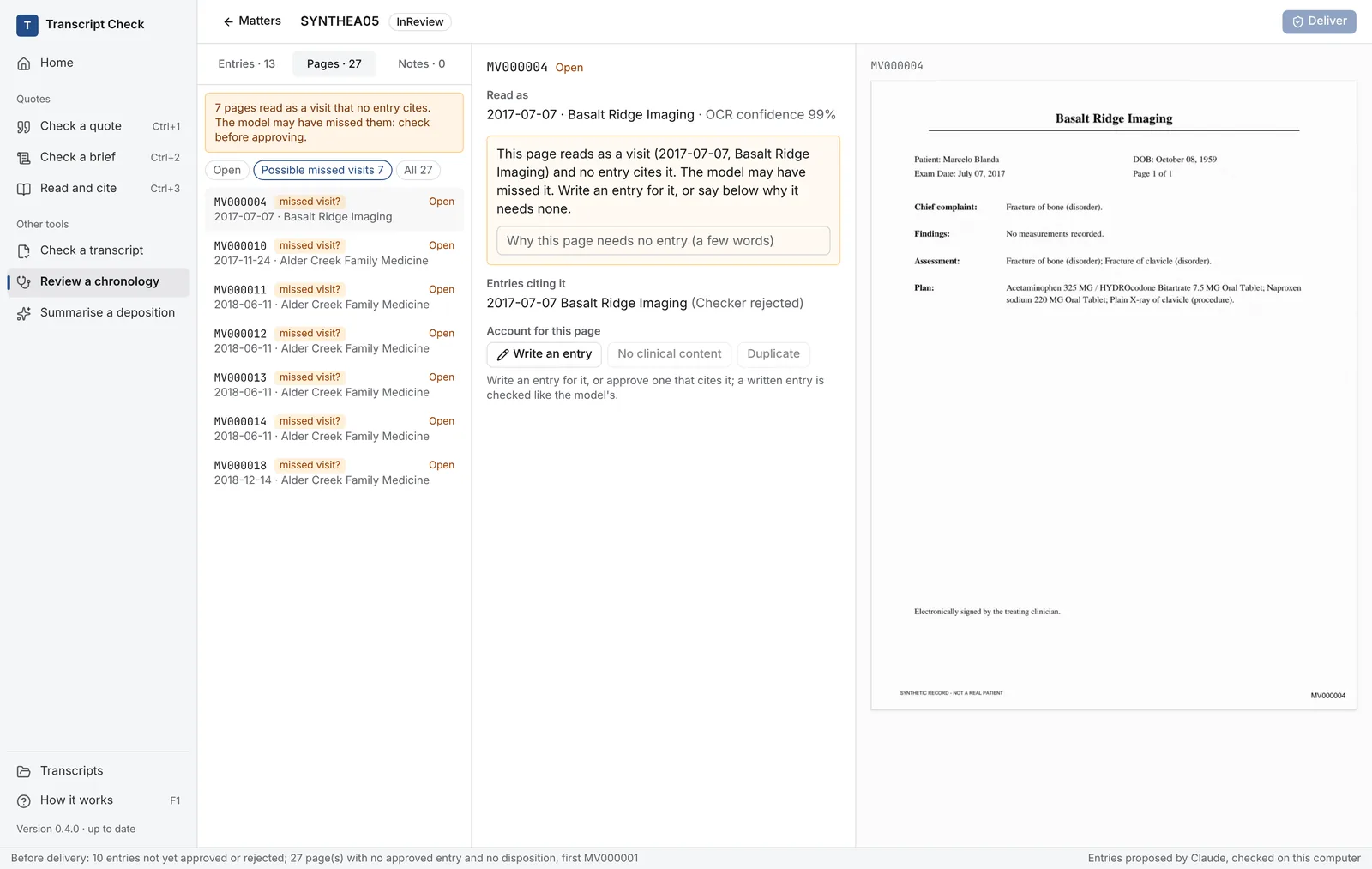
A page that reads as a visit, with no entry citing it, is listed as a possible missed visit. The reviewer writes the entry or says why none is needed.
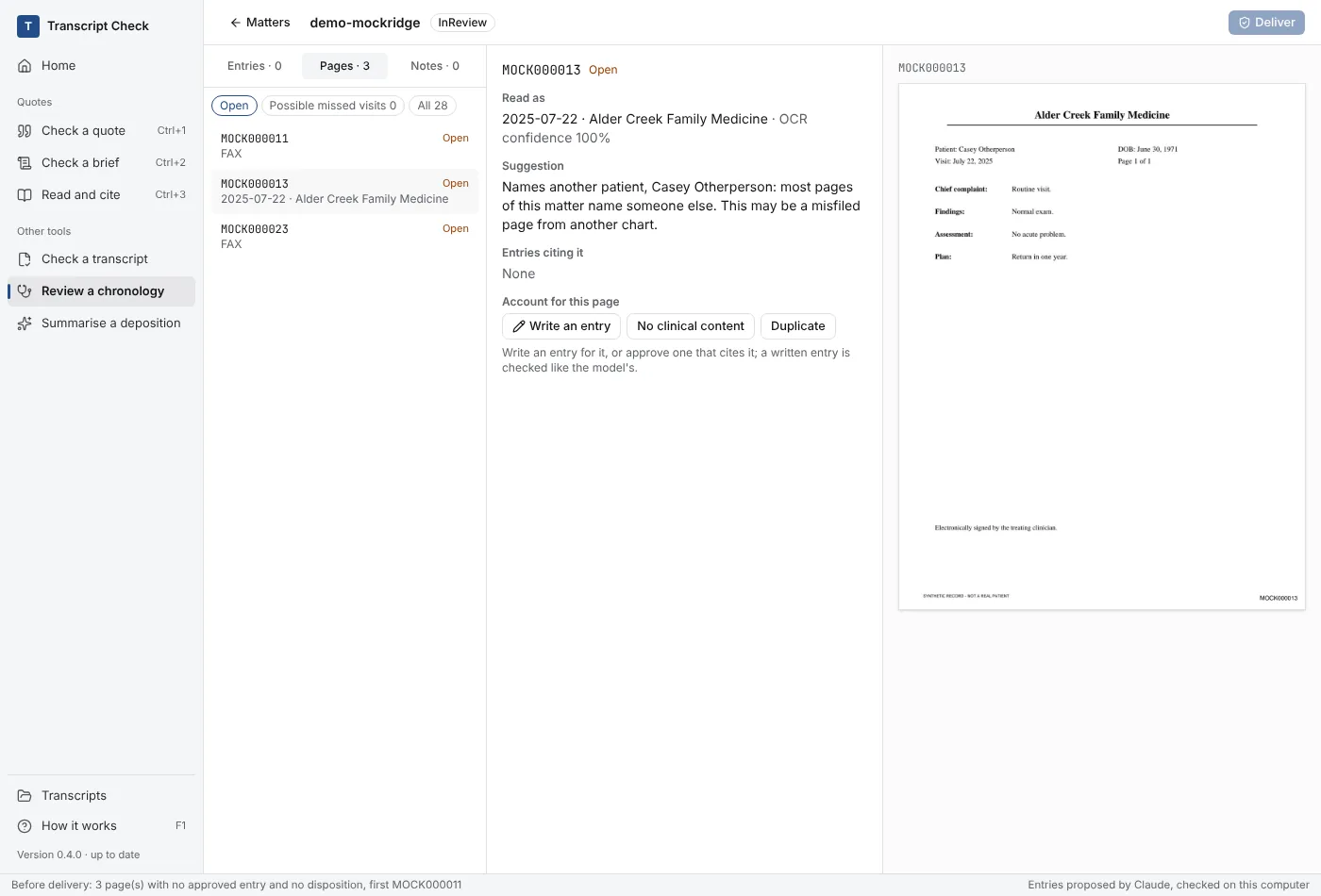
When most pages name one person and a page names someone else, it is flagged as possibly misfiled.
A second copy of a page is suggested as a duplicate. It keeps its Bates number and stays in the page list.
No entry may cite a low page until a person has checked its text. For a handwritten page, the reviewer types what it says and the report marks the text as typed by the reviewer.
Bill pages are matched to their visit. When the reviewer adds a bill, its amount reaches the report, and one bill cannot be counted twice.
The review screen refuses to open records on a disk that is not encrypted.
 Open full size
 Open full size
Delivery and purge
Delivery waits until every entry is approved or rejected and every page has an entry or a reason. The chronology is written as a Word document, a PDF and an Excel sheet from approved entries only.
Each file is then opened again by code and compared with what the reviewer approved. If a file does not match, it is not offered.
After delivery, the records, the entries and the service's copy of the report are deleted on a set date, 30 days later by default. The page list and the reviewer's decisions about each page are kept as a record of what was done.
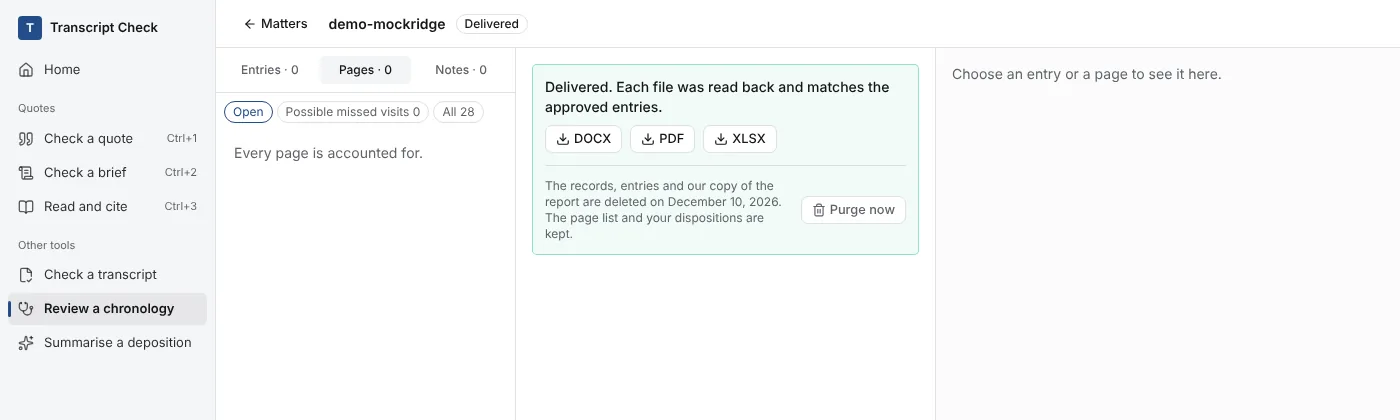 Open full size
Measured, in our own tests, on synthetic records
2,824 pages and 1,136 visits. On 10 Nov 2026 we re-ran the checks, delivery and purge on them (OCR text for 37 of the 42 cases was kept from the 7 Nov run). This run used no model: the entries tested were exact quotes from an answer key, plus errors planted on purpose. It measures the checker, not a model's drafting.
Limits
This is the least proven of the three tools. Read these before anything else on this page.
]as
lin a medication list, so a true quote no longer matched its page. Refusing is the safe outcome, and it leaves the entry for the reviewer to fix.
No clinical content,
Duplicateor
Write an entry.
The demo shows the invented plaintiff's 28 pages of records, with the checker's verdicts on true entries and on planted slips.